Certainty of Misgivings is British satire about avoidable situations and the calm, confident decisions that make them worse. From everyday human misjudgement to institutions and public life, it observes manageable circumstances becoming needlessly complicated—with understatement, restraint, and a firmly maintained stiff upper lip.Beyond the satire, you'll also find Detours & Daydreams, a newsletter of stories, ideas and discoveries worth getting distracted by; Roads Returned, where overlooked journeys and forgotten places are revisited; and The Shop, home to original apparel, prints and artefacts from across the collection of brands.

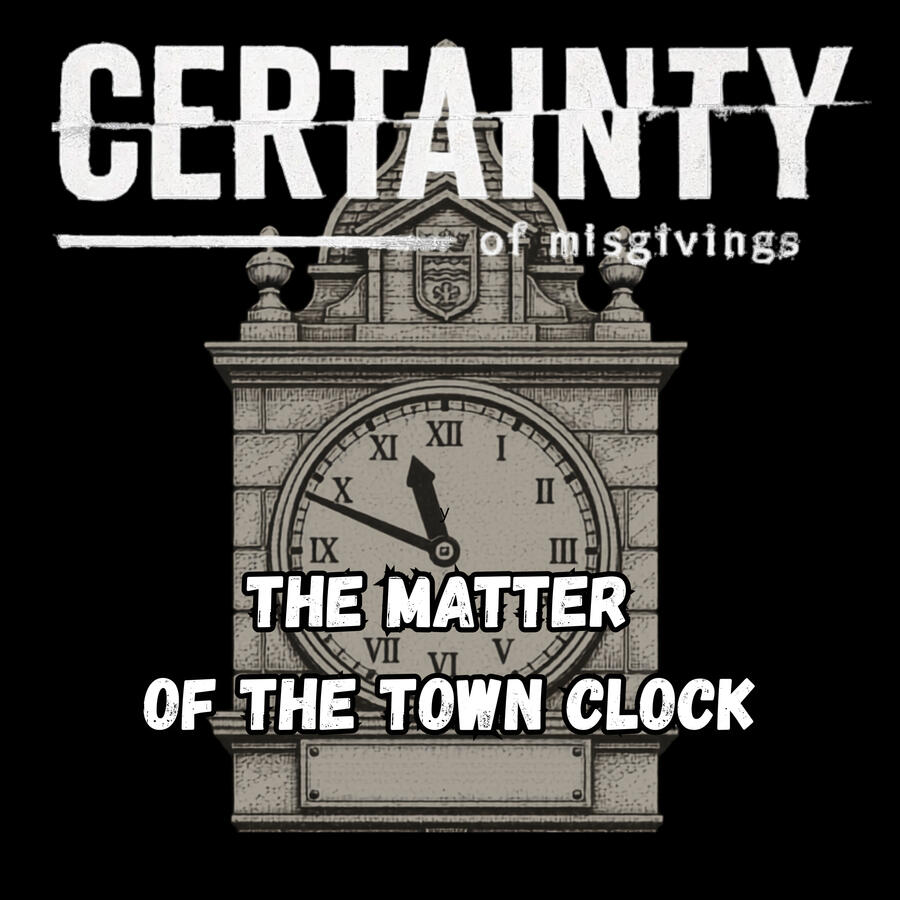
The Matter of the Town Clock
When the town clock falls twelve minutes behind, the authorities set about ensuring it stays there—properly.
The Special Meeting
Highland Council’s special meeting lost the decision it was convened to make, but discovered that the meeting itself still required attention.
The Applicable Plan
An organisation responsible for assessing competence discovered that its own assessment process had not quite passed.
The town clock was twelve minutes slow.This was first noticed by the market supervisor, who had begun closing the eastern gate while several people still believed themselves entitled to enter. The people referred to the clock. The supervisor referred to his watch.Both were functioning.The clock was inspected from the pavement. Its hands moved correctly and at an appropriate pace. They were merely doing so twelve minutes behind everyone else.A notice was placed in the council window.It advised residents that the time displayed on the clock should not be relied upon until further notice. The window stood directly beneath the clock, although the notice could not be read from the pavement without first passing out of sight of it.This was considered adequate.Adjustment of the clock required a brass key held by the Property Office. The Property Office was prepared to release it upon receipt of written authority from Civic Services. Civic Services requested confirmation that changing the time would not constitute an alteration to a heritage asset.The Heritage Officer could find no objection to the clock being accurate. He did, however, advise against changing its established appearance without consultation.A working group was formed.Property recommended moving the hands forward by twelve minutes. Communications warned that an unexplained change of this kind might confuse residents who had become accustomed to allowing for the discrepancy. Legal Services asked whether the correct time could be regarded as a public service and, if so, whether the council had formally undertaken to provide it.No such undertaking could be located.Pending clarification, two definitions were adopted. “Displayed time” meant the time shown by the clock. “Operational time” meant the time used for council business. Staff were instructed to distinguish between them in all correspondence.This introduced some complications.A clock specialist was booked for nine o’clock on Thursday. He arrived at nine according to his telephone. The caretaker arrived when the town clock showed nine. The specialist’s access window was ten minutes.They did not meet.For the second appointment, an officer from Civic Services attended to ensure that all parties were working to a common standard. Her confirmation email specified nine o’clock operational time. Property amended this to nine o’clock displayed time because the work concerned the displayed clock.The specialist received both messages.He sought clarification. The request was referred to the working group, whose next meeting began twelve minutes late after half its members followed the clock and the remainder followed the agenda.It was agreed that public opinion should be obtained.The consultation asked whether the town ought to possess a reliable public indication of time. Ninety-four per cent of respondents agreed. Four per cent preferred no change. Two per cent submitted observations concerning parking, which were forwarded elsewhere.The result demonstrated a clear preference for reliability. It did not establish which time residents wished to rely upon.An alignment exercise was therefore arranged. At ten on Monday morning, all council clocks, watches and office systems were to be brought temporarily into agreement with the town clock. This would permit the discrepancy to be assessed under controlled conditions.Some staff adjusted their watches. Others altered wall clocks. The computer system declined to participate.A departmental meeting was recorded as having ended before it began. Two officers arrived simultaneously at different times. The public counter closed punctually, although there was disagreement about whether this had occurred early or late.The exercise was judged informative.The working group’s final report accepted that the clock could be corrected in several minutes by a person possessing the brass key. It also concluded that immediate adjustment would remove the basis upon which the consultation, terminology and alignment procedures had been developed.A transitional arrangement was preferred.A plaque was fixed beneath the clock stating that the time shown was indicative and should be confirmed independently. The lettering was made large enough to be read from the pavement. This required part of the clock face to be obscured.The clock remains twelve minutes slow.It is now, however, doing so in accordance with an agreed framework.
The Special Meeting
Highland Council discovered that a meeting may lose the decision it was convened to make without suffering any corresponding loss of importance.
Highland Council had arranged a Special Meeting for eleven o’clock on Tuesday morning.
The capital letters were appropriate. This was not one of the council’s ordinary meetings, in which ordinary matters are subjected to the ordinary quantity of consideration. It had been convened to reconsider a decision made by the Licensing Committee on 23 June. The step was described by the council as extremely unusual, reflecting the seriousness and urgency with which the matter was being treated.
By Monday afternoon, however, the two licences at the centre of the decision had been surrendered.
The council announced that they had ceased to have effect immediately. There was therefore no longer any legal basis for reconsidering the Licensing Committee’s decision and, as the urgent motion later put it, “no decision for the special Council to reach”.
This might have presented a difficulty to a lesser meeting.
A village-hall subcommittee, finding itself without anything to decide, might have allowed the tea urn to cool and returned the key. A departmental catch-up might have been cancelled with the brisk insertion of the word Update into its calendar invitation. But this was a Special Meeting of Highland Council. Considerable administrative care had brought it safely to the edge of existence. It was not going to be deterred by the disappearance of the reason for holding it.
The meeting would proceed.
Its new business was an urgent motion supporting the decision to bring the original decision before the special meeting. The motion acknowledged that there was now no decision for the special meeting to reach, but wished it to be known that the unprecedented action of arranging the meeting had been justified.
This produced a pleasingly complete piece of public administration.
The original decision could no longer be reconsidered. The decision to reconsider it could, however, be considered. And because the reconsideration could not take place, the consideration of having intended to reconsider it acquired an urgency of its own.
It is important to be fair. The meeting was not about nothing.
The motion also requested that the Scottish Government review the rules, regulations and eligibility criteria applying to licences associated with the taxi industry. That was a substantive proposal arising from a serious matter. Members approved it, and a letter is to be sent.
But the council had nevertheless arrived at a rare procedural position. It had convened a meeting to reach a decision, lost the decision, retained the meeting and used it partly to confirm that convening a meeting to reach the decision it could no longer reach had been the correct decision.
There are institutions which would regard this as an unfortunate change of agenda. Highland Council managed to give it the dignity of a conclusion.
This is one of the advantages of procedure. Purpose may be exposed to events, but procedure has minutes.
Once a chamber has been reserved, papers circulated, members summoned and an action described as unprecedented, cancellation can appear almost impertinent. Circumstances may change, but circumstances have not read the standing orders. Nor have they considered the amount of work already carried out on their behalf.
A process in motion develops certain reasonable expectations. Chief among them is that it will eventually be declared reasonable.
Thus the meeting assembled. Members supported the earlier referral. The proposed letter to the Scottish Government was approved. The unprecedented action was formally described as justified. The meeting had lost its original destination but reached an orderly position from which everybody could confirm that setting out had been necessary.
Further proceedings were also indicated.
The council’s Convener, Leader and Leader of the Opposition announced their intention to bring a motion of no confidence in five members of the Licensing Committee to the council’s September meeting. This is, at present, an intention rather than a completed decision. The machinery has not raced ahead of the record. It has merely booked the next available platform.
By Tuesday afternoon, the original licensing decision was no longer available for the full council to reconsider. Its absence had nevertheless supported an urgent motion, an institutional endorsement, a proposed governmental review and notice of another motion to come.
The Special Meeting had been convened to decide something.
When there was nothing left for it to decide about the original matter, it proceeded to establish that deciding to convene it had been justified.
The decision had gone.
The proceedings continued.